- No.
- LM-W-002
- Filed
- Role
- Sole engineer
- Stack
- DTCG tokens Node Hugo Modules npm
- Status
- Building
MotifSpec
A design system of DTCG tokens, component rules and generated CSS, written so people and AI assistants can follow it.
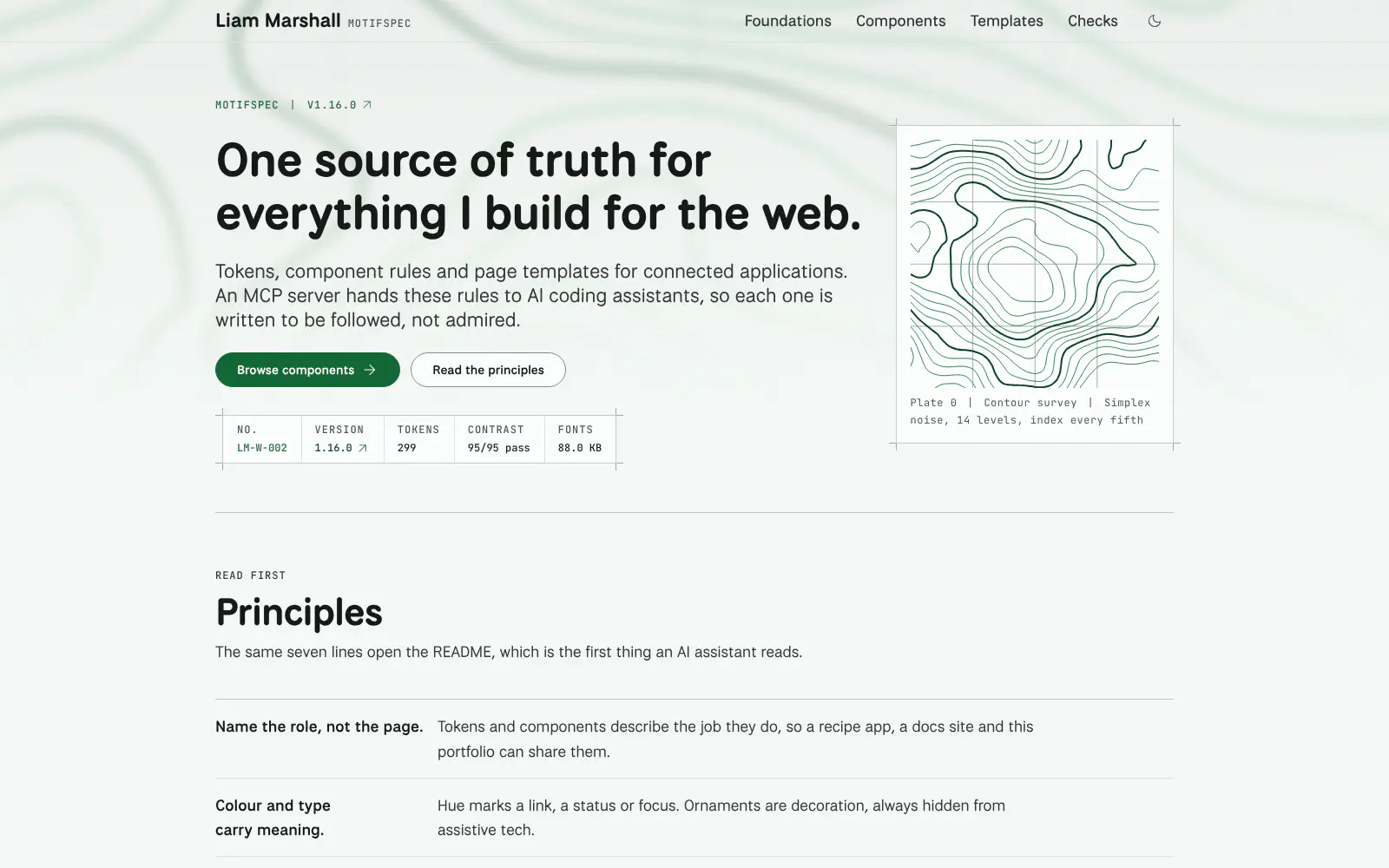
MotifSpec is the one place my projects get their colours, type, spacing and components from. It was called brand-codex until version 1.10.0. It ships as a Hugo module and an npm package, and every rule in it is written as an instruction, because an AI coding assistant reads it as often as I do.
You can browse it at motifspec.com, the showcase in Plate 1: its foundations, components, page templates and checks, built from the same files that sites import.
Problem #
Each new project started by copying CSS from the last one. Values drifted, dark mode was an afterthought, and contrast was checked by eye, if at all. When I asked an assistant to add a page, it invented new colours because nothing told it which ones existed or what they were for.
Constraints #
- No runtime dependencies. The build is plain Node, so it runs anywhere and nothing has to be updated to keep it working.
- Both themes are first class. Every colour has a light and a dark value, and both are measured.
- Pinnable releases. Sites import a tagged version and only change when I move the pin.
- Readable by machines. Every semantic token carries a usage rule in its description, not just a value.
Approach #
Tokens with usage rules
Tokens follow the Design Tokens Community Group format in two tiers. Primitives hold raw values; semantic tokens alias them and say when to use them. A site only ever sees the semantic tier.
"accent": {
  "border": {
    "$value": "{primitive.color.sap.600}",
    "$type": "color",
    "$description": "Accent rules that mark the active item. Not for static decoration."
  }
}
Contrast as a build step
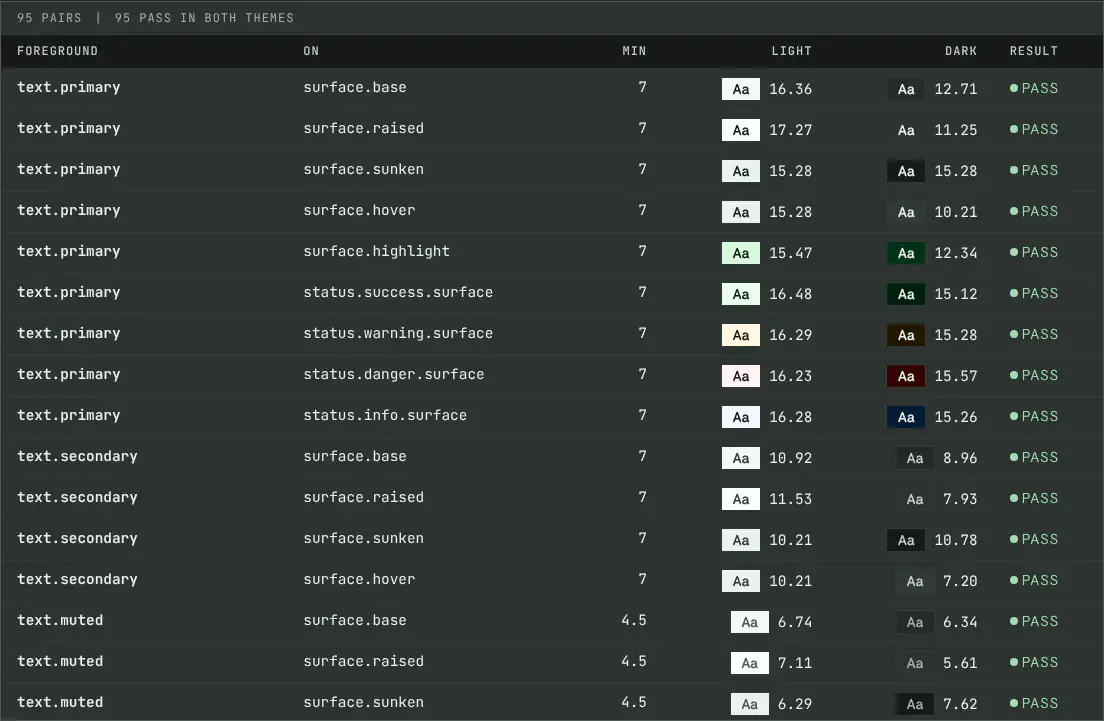
Foreground tokens declare which surfaces they sit on and the ratio they need: seven for reading text, four and a half for labels, three for controls and graphics. The validator measures every pair in both themes, and the build stops if one fails.
Hugo as the delivery format
The repository is also a Hugo module. Its own configuration mounts the generated files and the fonts, so a site needs one import line and a pinned version. The module also carries a Hugo partial for every component and the render hooks that turn Markdown into figures, tables, code blocks and callouts, so a site writes only its page templates and content. When a partial and its component doc disagree, the doc is the contract: the partial is fixed here, and every site gets the fix with the next release.
Projects that aren’t Hugo sites install the same release from npm as @aitrien/motifspec, pinned to an exact version.
Outcome #
Version 1.7.0 was the first tagged release, and this site was the first consumer. MotifSpec is now at 1.16.0.
| Measure | Value |
|---|---|
| Tokens | 299 |
| Semantic tokens | 153 |
| Contrast pairs, each checked in two themes | 95 |
| Component docs | 20 |
| Icons in the sprite | 16 |
| Font payload in KB | 88.0 |
| Releases from 1.0.0 to 1.16.0 | 29 |
The showcase is published at motifspec.com with every release, alongside the npm package and an MCP server for AI assistants. MotifSpec MCP server and release pipeline covers how a release reaches each of them.
What I’d change #
I would start with deprecation rules on day one. Removing two unused tokens forced a choice between a major version, which changes the module path, and keeping them a little longer. The second option was right, and now the validator enforces it.
- No.
- LM-W-002
- Filed
- Role
- Sole engineer
- Stack
- DTCG tokens Node Hugo Modules npm
- Status
- Building
Filed under